An honest answer from the workshop floor — what MDF really is, how long it lasts, where it beats plywood and solid timber, and the one place it will let you down.
Yes — and the kitchen you are picturing is probably already made of it
Quick answer
Yes, MDF kitchen cabinets are good — and for painted doors they are the best choice available. MDF has no grain to telegraph through paint, no knots and no seasonal movement, so a 2-pac finish stays flat and crack-free. Its one real weakness is standing water, which is a sealing and installation problem, not a material one.
Every week someone sits at our bench, looks at a quote, and asks the same thing in a slightly embarrassed voice: "but isn't that just MDF?" There is an assumption buried in the question — that MDF is the cheap option, the stuff flat-pack is made of, the corner somebody is cutting. It is worth clearing up, because the assumption is mostly backwards.
Walk into almost any beautiful painted kitchen in Melbourne — the crisp white shaker, the deep navy island, the handleless matt-grey run that looks like furniture — and you are looking at MDF. Not as a compromise. As the correct material for the job. If those doors had been made from solid timber, they would have moved with the seasons and cracked the paint at every joint within a few years.
So the honest answer to "are MDF kitchen cabinets any good" is yes, with one condition attached. MDF is excellent at nearly everything a kitchen door has to do, and genuinely poor at one thing: sitting in water. Everything else in this guide follows from that single trade-off.
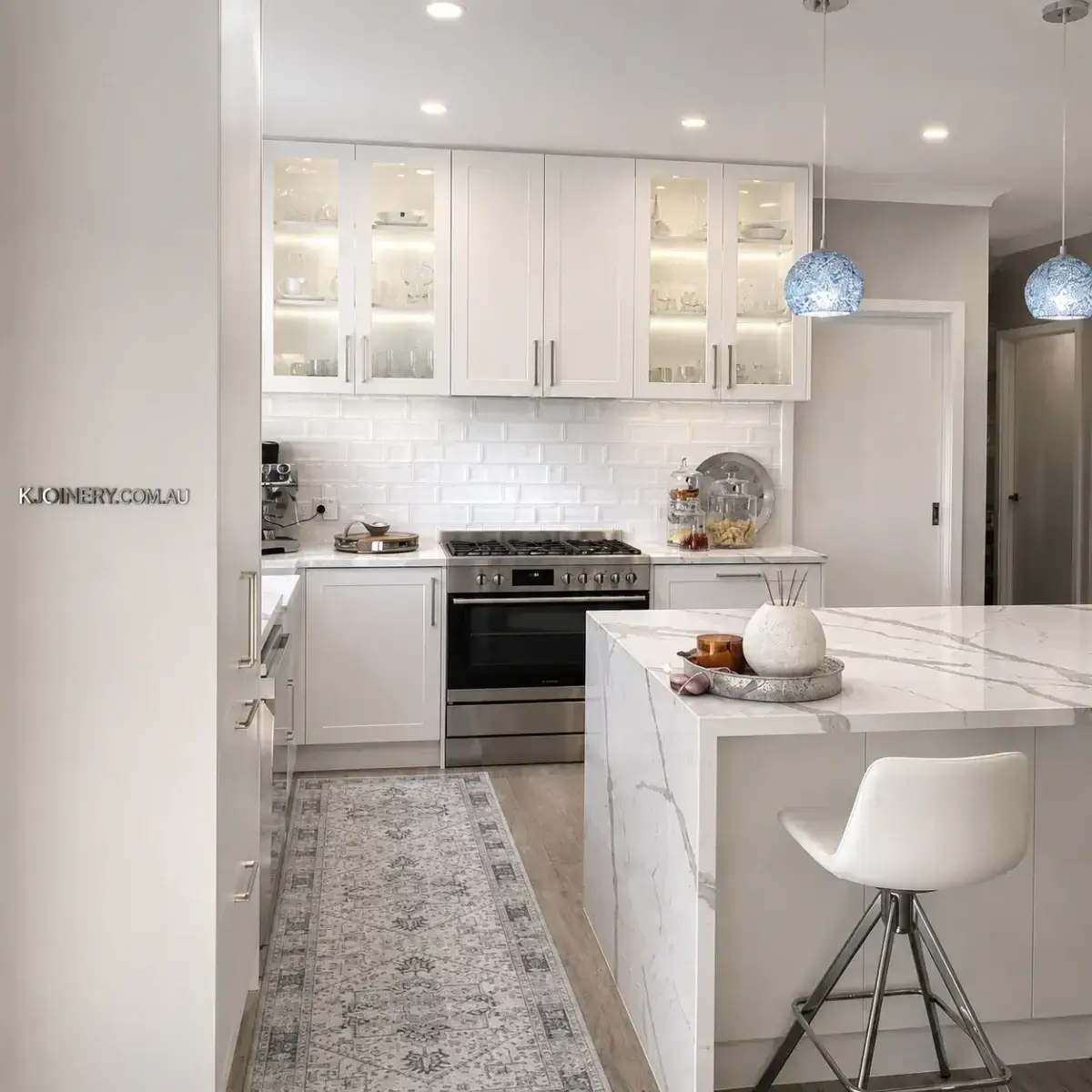
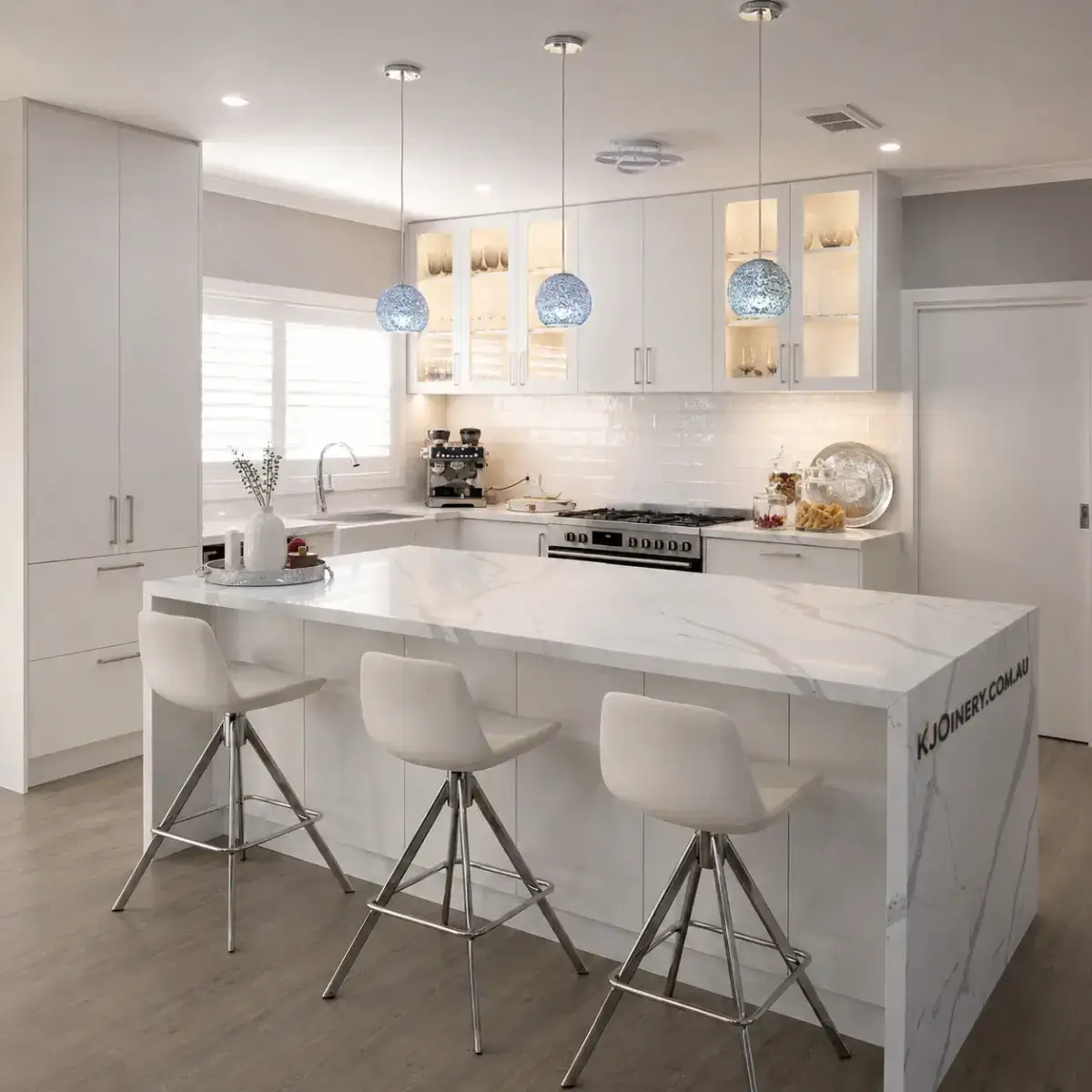
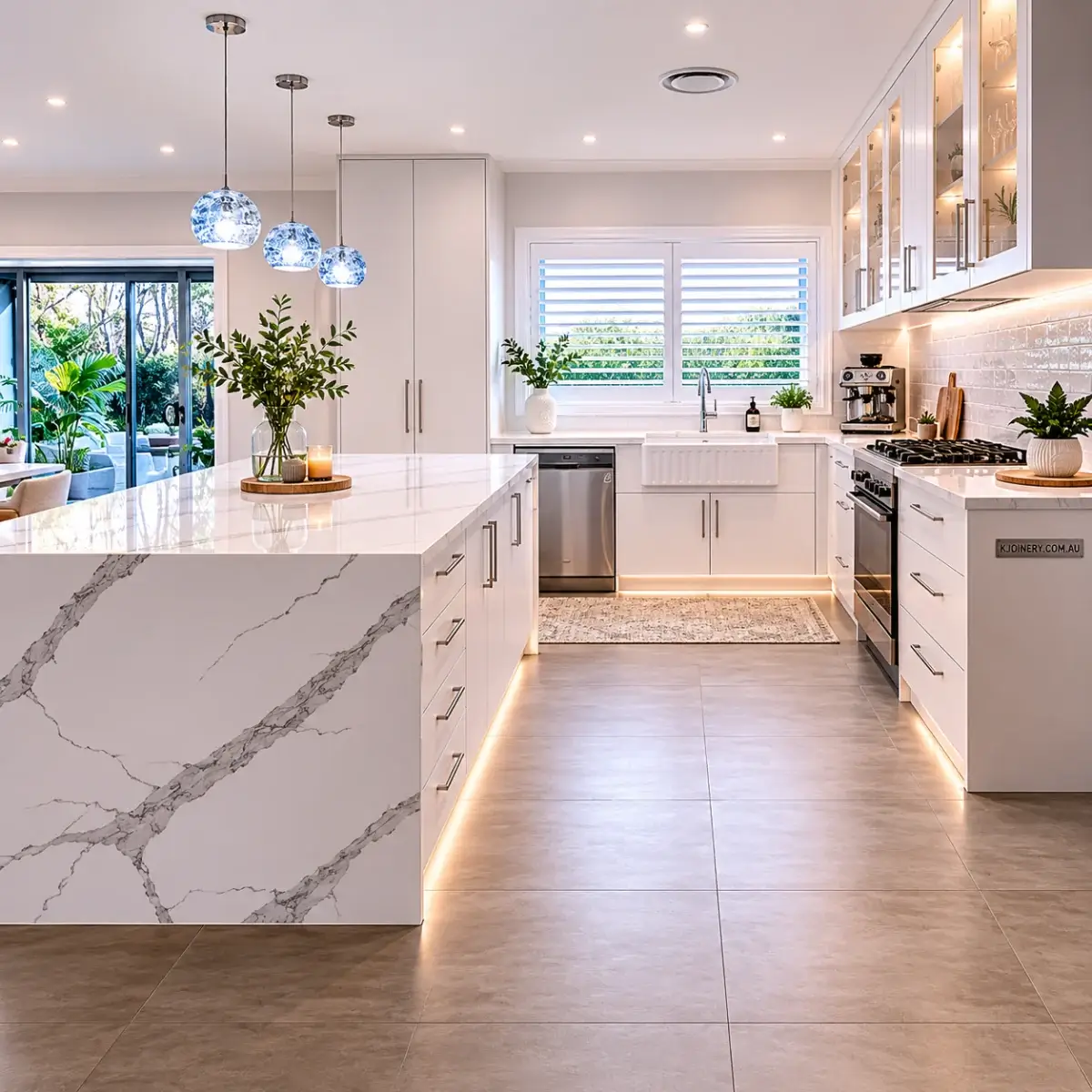
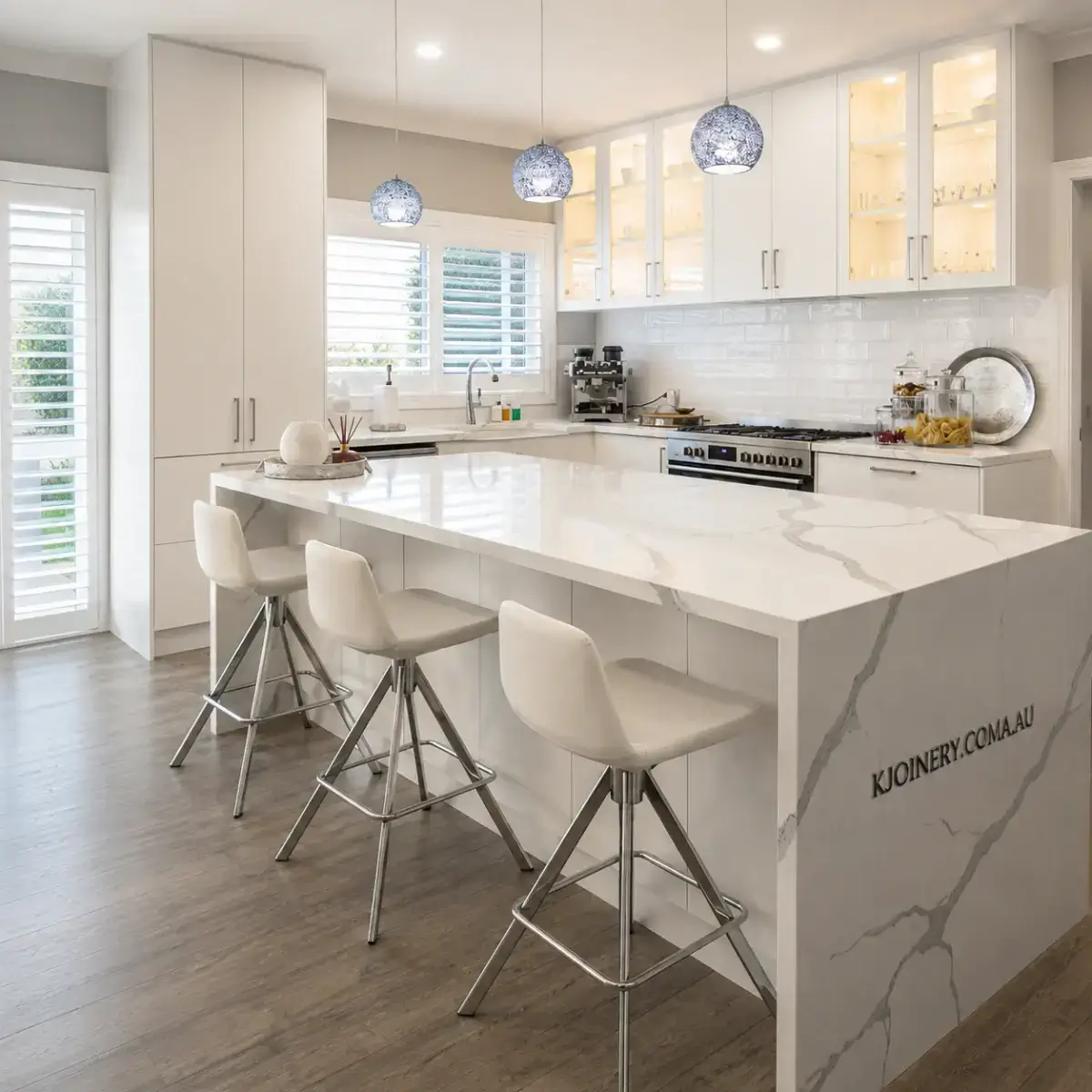
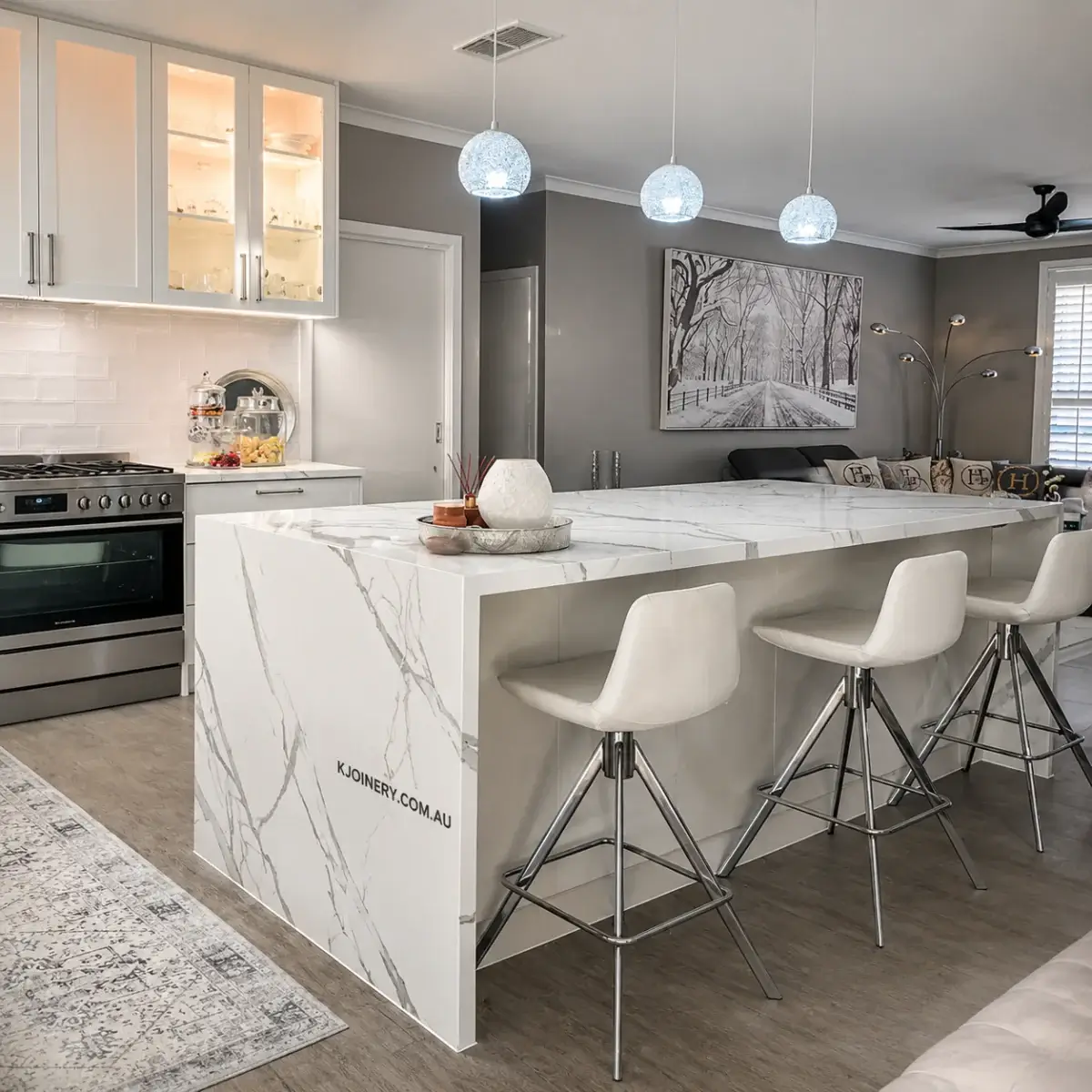
A classic painted shaker kitchen. The doors are MDF, and that is exactly why the paint still looks like this.
MDF is not the cheap version of timber. It is a different material that happens to be better at holding paint.
02 · Lifespan
How long do MDF cabinets last?
Quick answer
Well-made MDF kitchen cabinets last 15 to 25 years, and often longer. In practice the board almost never fails first. Hinges, drawer runners and the paint finish wear out well before the MDF does, and all three can be replaced without touching the cabinet boxes.
This is the question we get asked most, usually phrased as "how long before I have to do this all again". The reassuring part of the answer is that MDF is not what decides it.
Think about what actually kills a kitchen. It is rarely the cabinet. It is a drawer that no longer glides because the runner is shot. It is a door hanging half a centimetre low because a cheap hinge has given up. It is a finish that has yellowed, chipped at the edges, or simply gone out of fashion. In a kitchen built properly, the MDF underneath all of that is usually still dead flat and perfectly square.
We have pulled out kitchens from the early 2000s where the doors were tired and the hardware was finished, and the carcases were so sound the owners kept them and just replaced the fronts. That is a genuinely cheaper renovation, and it is only possible because the board held its shape for twenty years.
What actually wears out first
Drawer runners & hinges8–15 yrs
The first thing to go, and the cheapest to fix. Quality German hardware roughly doubles this.
Paint or 2-pac finish12–20 yrs
Chips at high-traffic edges long before it fails as a coating. Can be re-sprayed.
MDF doors & panels20–30 yrs
Stays flat and square as long as edges stay sealed and dry.
Cabinet carcases25–40 yrs
Boxes routinely outlive two sets of doors. Worth keeping in a refresh.
Those are working numbers from kitchens we have built, removed and repaired — not laboratory figures. A kitchen in a quiet couple's home will sit at the top of every range. A kitchen feeding four teenagers will sit at the bottom. What moves the needle most is not the board; it is whether the hardware was worth the money and whether anyone dealt with the leak under the sink.
Built to be lived in. The finish and the hardware are what will date first, not the board behind them.
03 · The Material
What MDF actually is (and the grade that matters)
MDF stands for medium density fibreboard. Timber is broken down into individual wood fibres, mixed with resin, and pressed under heat into a panel of completely uniform density. There is no grain direction, no knots, no natural voids and no weak spots. It is the same all the way through, which is precisely why it behaves so well under a router and a spray gun.
That uniformity is the whole point. Solid timber is stronger, but it is also alive — it expands and contracts across the grain as humidity changes through a Melbourne year. Paint a timber door and the joints will eventually show hairline cracks where the panel has moved. Paint an MDF door and it stays exactly as flat as the day it was sprayed.
The three grades, and why you only want one of them
Here is where most of the bad reputation comes from. People say "MDF" as though it is one material. It is not, and the difference between the grades is the difference between a kitchen that lasts and a kitchen that swells.
Standard MDF — the raw brown board. Fine for wardrobe interiors, bookshelves, wall panelling and anywhere that stays dry. It has no moisture resistance at all and has no business being under a kitchen sink.
MR (moisture resistant) — usually dyed green so it can be identified on site. A water-resistant resin lets it shrug off splashes and steam. This is the sensible minimum for kitchen and laundry cabinetry.
HMR (high moisture resistance) — the same idea taken further. This is what belongs in wet zones: under the sink, beside the dishwasher, in laundries and bathrooms.
When someone tells you a horror story about MDF swelling up like a sponge, they are almost always describing standard MDF used where MR or HMR should have been. The material did not fail. The specification did. Ask any cabinet maker which grade they are quoting on, and if the answer is vague, that tells you something useful.
Two other things worth knowing. Australian MDF is manufactured to AS/NZS 1859.2, so board from a reputable supplier is a known quantity rather than a gamble. And formaldehyde emission is rated by class — E0 is the low-emission standard you want in a home, and it is what we specify as standard.
Behind the doors is where quality shows — board grade, edge sealing and the hardware doing the daily work.
The Number That Matters
MRthe minimum grade for any kitchen
Standard MDF in a kitchen is where the horror stories come from. Moisture-resistant board in the dry zones and high-moisture board in the wet zones is what separates a twenty-year kitchen from a five-year one.
04 · The Comparison
MDF vs plywood vs particleboard vs solid timber
Quick answer
MDF wins for painted doors, plywood wins for wet areas and heavy loads. Plywood holds screws better and survives moisture far more forgivingly, but its grain telegraphs through paint. Particleboard is cheaper and weaker. Solid timber looks best in a natural finish but moves seasonally and cracks paint at the joints.
There is no single best material, which is why anyone who tells you otherwise is selling something. Each one is good at a different job, and a well-built kitchen usually contains more than one of them. Here is the honest comparison.
Scroll the table sideways on a phone.
MDF
Plywood
Particleboard
Solid timber
Painted finish
Excellent — no grain, glass-flat
Fair — grain telegraphs through
Poor — coarse, rough edges
Fair — cracks at joints over time
Water tolerance
Weak unsealed, good as HMR
Best — recovers from a soaking
Poor — swells fastest
Good — but stains and cups
Screw holding
Good in face, fair in edge
Best — holds in every direction
Weakest — strips easily
Excellent
Machined detail
Best — routs crisply, no tear-out
Fair — edges need covering
Poor — crumbles at detail
Good — but knots and grain fight you
Stays flat
Excellent — no seasonal movement
Very good
Good
Poor — moves all year
Weight
Heavy
Light
Heavy
Varies
Relative cost
Mid
High
Lowest
Highest
Best used for
Painted doors, panels, curves
Wet-zone boxes, heavy shelving
Budget carcases
Natural-finish doors, benchtops
Read across the "painted finish" row and you have the entire argument. If your kitchen is going to be a colour rather than a timber, MDF is not a compromise you are accepting — it is the material that gives you the finish you actually want. Plywood under paint will show its grain within a year or two as the coating settles. Timber will crack where the rails meet the stiles. MDF will just stay flat.
Flip it around and the logic still holds. If you want to see and feel real timber, MDF cannot help you — nothing fakes genuine oak. That is a job for solid timber or veneer, and we will happily build it that way.
When timber is the right call
Natural finish
You want visible grain and warmth
Oiled or clear-coated, not painted
Happy with slight seasonal movement
Budget sits at the top bracket
When MDF is the right call
Painted finish
You want a colour, not a timber
Shaker profiles or handleless slabs
A finish that stays flat for decades
Best value per dollar of the four
05 · Where It Wins
Four things MDF does that timber simply cannot
Most guides treat MDF as the budget option and stop there. That misses what it is genuinely, specifically better at — the reasons a cabinet maker reaches for it even when money is not the constraint.
01
It goes where timber will not
Because MDF has no grain direction, it can be cut, routed and shaped in any direction without splitting or tearing out. Awkward angles, under-stair runs, curved ends, tapered fillers — all straightforward. In solid timber the same job means jointing, and every joint is a future crack.
02
It takes paint better than anything else
A 2-pac or polyurethane finish sprayed onto MDF gives a surface with genuine depth and no texture underneath it. There is no grain to raise, no knot to bleed through, no filler patch to flash in the light. This is the single biggest reason painted kitchens are built from it.
03
It does not move with the weather
Melbourne swings from dry heat to damp cold and back again, sometimes in a week. Solid timber doors respond to that by expanding and contracting. MDF is dimensionally stable, so a set of doors lined up perfectly on installation day still lines up years later.
04
It comes in sizes timber does not
MDF arrives in large, perfectly consistent sheets, so a full-height pantry door or a tall panel can be one unbroken piece. The same door in solid timber has to be built up from several boards, and every one of those joins is somewhere the finish can eventually fail.
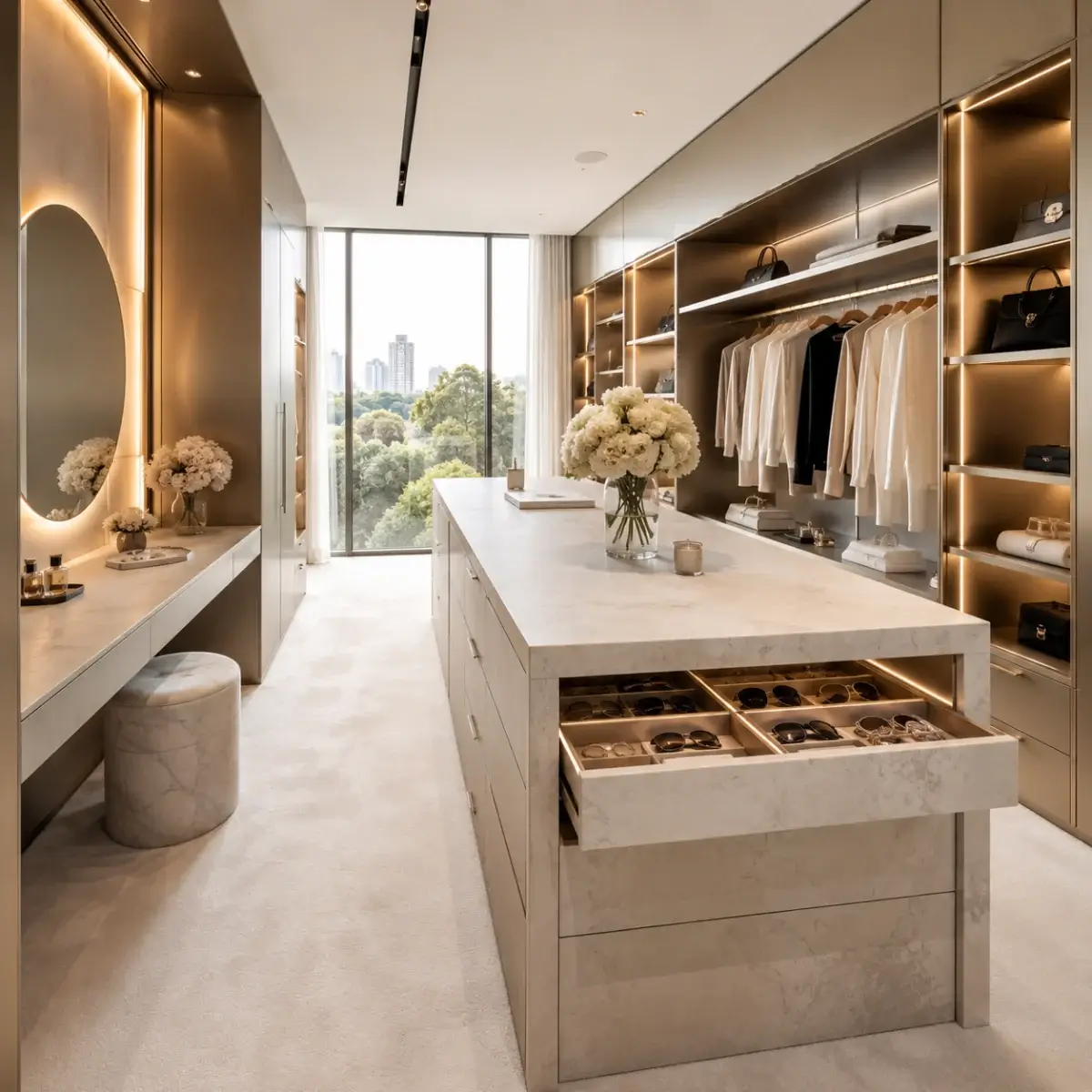
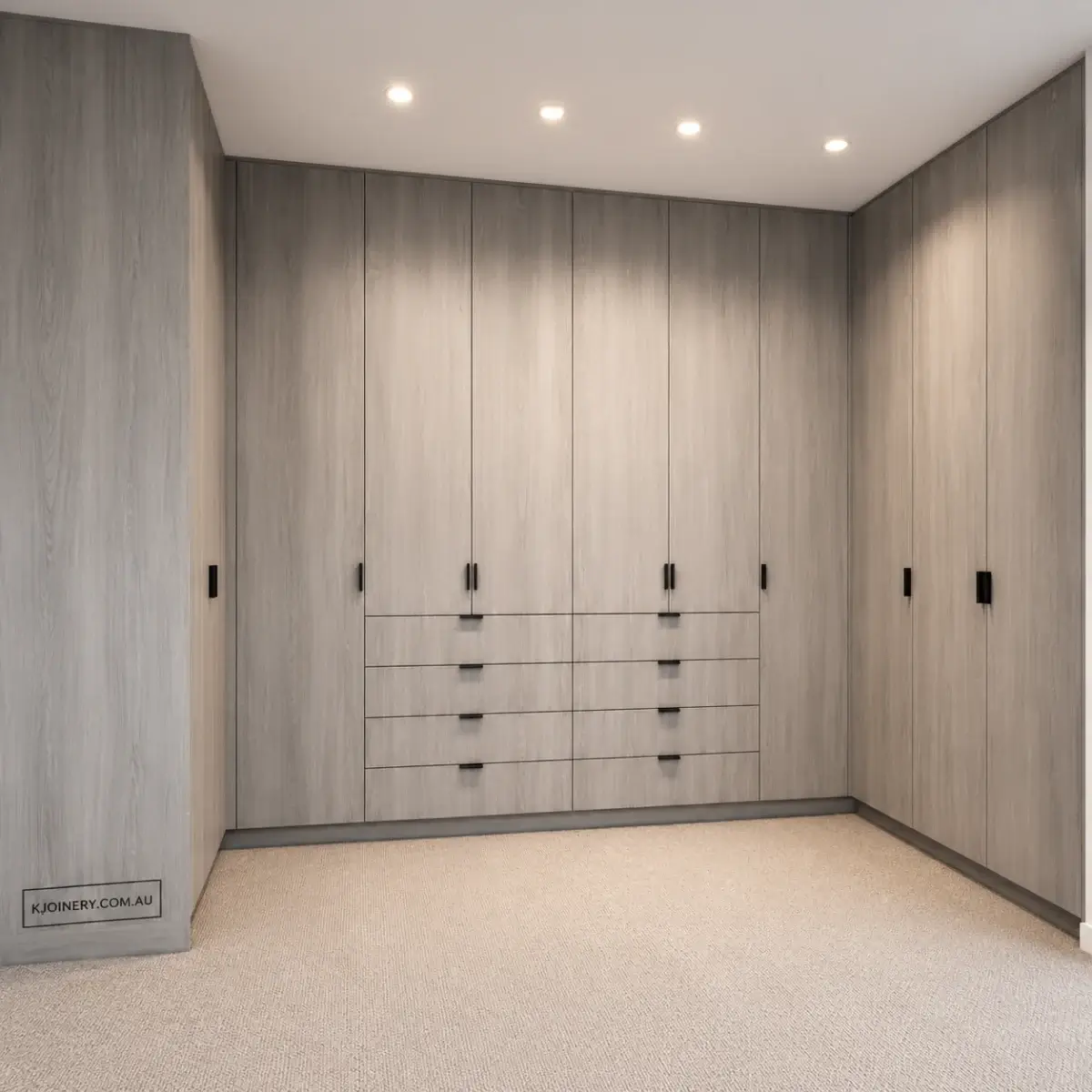
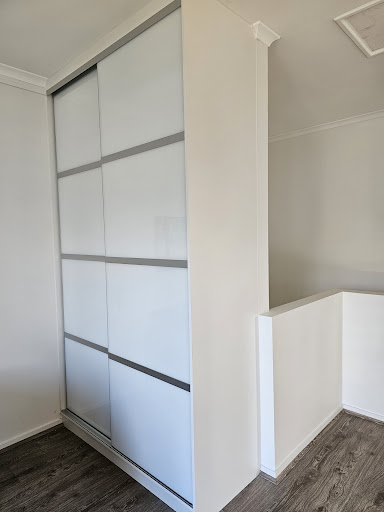
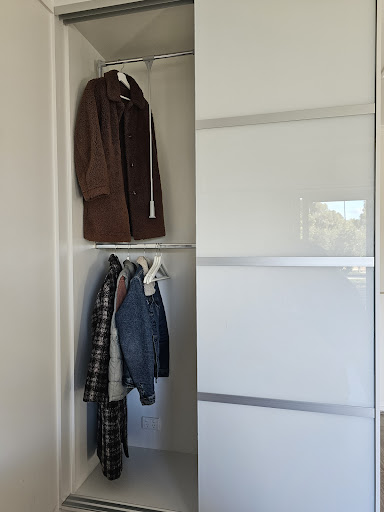
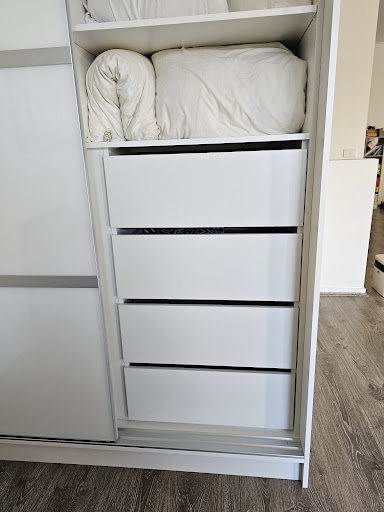
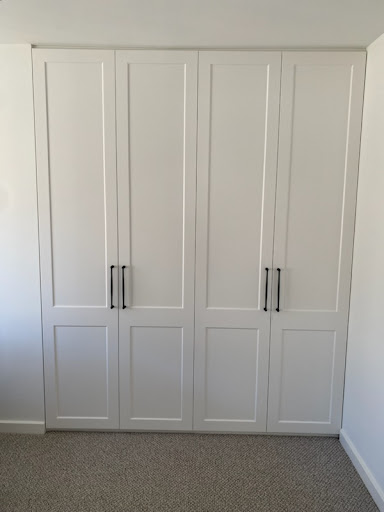
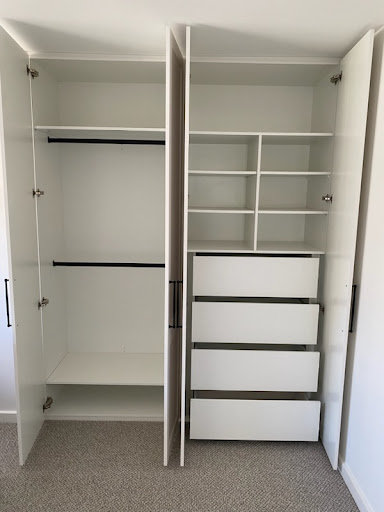
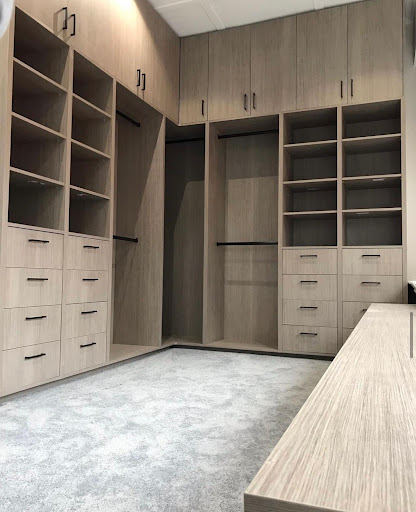
The same board, a different room — MDF is the backbone of most custom robes too.Dry rooms are where standard-grade board is perfectly at home.
06 · Straight Talk
Five things people believe about MDF that are not true
Some of these come from genuinely bad experiences with the wrong grade of board. Some come from confusing MDF with particleboard. Either way, they come up in nearly every consultation, so here they are with the honest version alongside.
The belief
"MDF is just chipboard with a fancy name."
The reality
They are different materials. Particleboard is made from coarse chips and flakes; MDF is made from fine individual fibres pressed to a uniform density. That is why MDF machines to a crisp edge and particleboard crumbles.
The belief
"MDF means it is a cheap kitchen."
The reality
Some of the most expensive painted kitchens in Melbourne are MDF, because there is no better substrate for a sprayed finish. Cost lives in the finish, the hardware and the build — not in whether the door is MDF.
The belief
"If it gets wet, the whole kitchen is ruined."
The reality
A wipe-up spill does nothing to sealed board. The damage case is water sitting against a raw, unsealed edge for days — typically a slow leak nobody noticed. That is a plumbing problem that would also destroy particleboard.
The belief
"MDF is full of dangerous chemicals."
The reality
Modern Australian board is rated for formaldehyde emission, and E0 is the low-emission class specified for homes. Once doors are sealed and sprayed, the surface you live with is cured paint.
The belief
"You cannot repair MDF."
The reality
A chipped painted MDF door is one of the easier repairs in a kitchen — fill, sand, re-spray, and it disappears. A dent in natural timber is far harder to hide because you also have to match the grain.
07 · The Honest Weakness
Where MDF genuinely lets you down
Quick answer
MDF fails when water reaches a raw, unsealed edge and stays there. The fibres absorb it and swell permanently — sanding will not bring the board back. Nearly every failure traces to one of three places: under the sink, beside the dishwasher, or along a bottom edge that was never sealed.
We would rather tell you this plainly than have you find out later. MDF has one real weakness and it is worth understanding properly, because knowing it is how you avoid it.
The board is made of compressed fibres. Get liquid water into an exposed edge and those fibres drink it, expand, and stay expanded. Unlike solid timber, which can dry out and shrink back to roughly where it started, MDF swelling is permanent. You cannot sand it flat again. That door is finished.
Here is the part that matters though: this is almost never a spill. Wiping down a sealed, painted door does nothing at all. The failure case is water sitting somewhere unseen for days or weeks — a slow drip from a tap connection, a dishwasher seal that has started weeping, a bottom edge that was cut on site and never resealed before the kicker went on.
How we build around it
HMR board in every wet zone. The sink base, the dishwasher surround and any laundry cabinetry get high-moisture board as standard, not as an upgrade you have to ask for.
Every cut edge sealed. Any edge cut on site — a scribe, a trimmed kicker, a service cut-out — gets sealed before it goes in. Unsealed site cuts are the most common failure we are called out to.
A raised or removable kicker. Keeping cabinet bases up off the floor means a mopping accident or a small leak has somewhere to go that is not the bottom of your cabinetry.
A sink base you can actually see into. If you can look under the sink easily, you will notice a drip in week one instead of month six. Most catastrophic swelling is simply a leak nobody spotted.
Do those four things and the weakness largely stops being a weakness. Skip them — particularly the sealed edges — and you get the horror story that gave MDF its reputation in the first place.
Wet zones get high-moisture board. It is a specification decision, made long before anything is built.
The Real Failure Point
1unsealed edge is all it takes
Not spills. Not steam. Not daily cooking. Almost every swollen cabinet we are called out to traces back to a single raw edge that met water and stayed wet.
08 · Before You Sign
Six questions to ask whoever quotes your kitchen
You do not need to become an expert on board grades to get this right. You just need to ask a few specific things and listen to how confidently they are answered. A cabinet maker who builds properly will enjoy these questions. One who does not will get vague.
What grade of board are the carcases, and what grade is under the sink? You want to hear moisture-resistant as the baseline and high-moisture in the wet zones. "Just standard MDF" throughout a kitchen is a red flag.
How thick are the cabinet boxes? Thicker board means less flex under a stone benchtop and better screw holding for hinges over the long run. It is a quiet indicator of overall build standard.
Are site-cut edges sealed before installation? Ask it exactly like that. The answer tells you whether they are thinking about year ten or just this week.
What hinges and runners are included, by brand? This is where a kitchen quietly gets cheap. Hardware is the first thing to fail and the line item most often downgraded to win a quote.
Is the finish 2-pac, vinyl wrap or laminate? All three are legitimate, at different prices and durability. What matters is that you know which one you are buying before you sign.
What is the warranty, and what does it actually cover? Ask specifically whether it covers water damage and what would void it. A straight answer here is worth more than a long list of inclusions.
MR board as standardHMR in wet zonesE0 low emissionSealed site cutsSoft-close hardwareFixed written quote
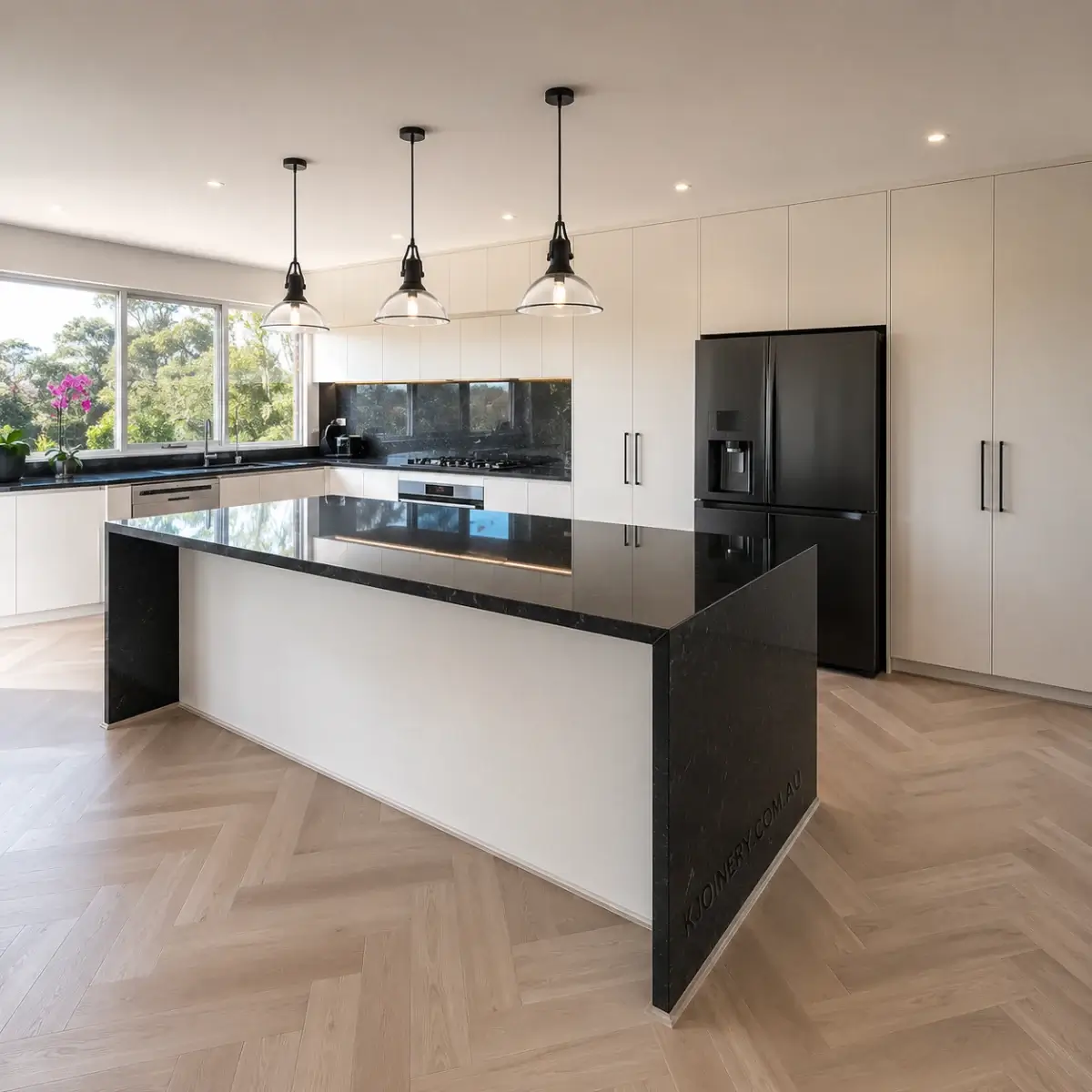
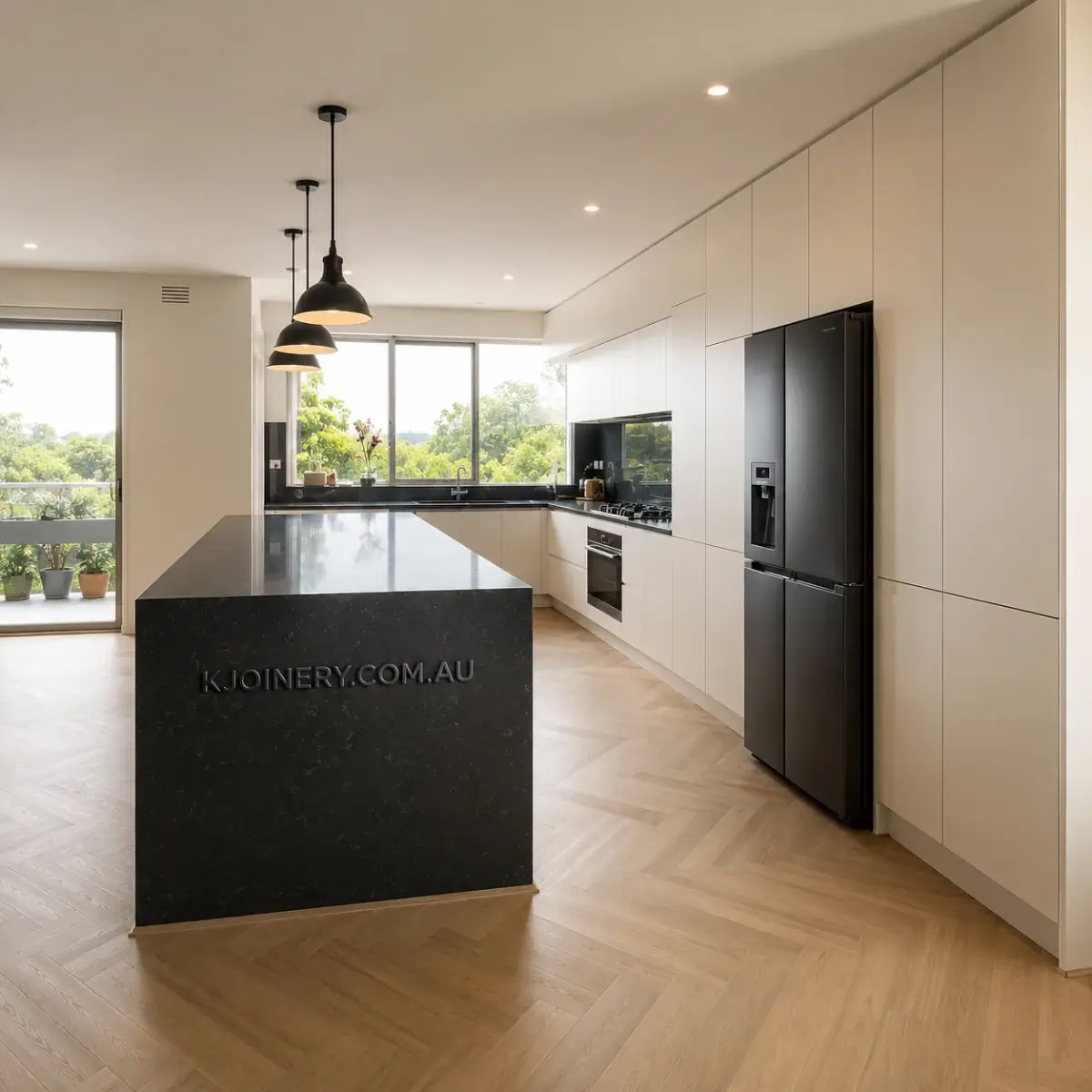
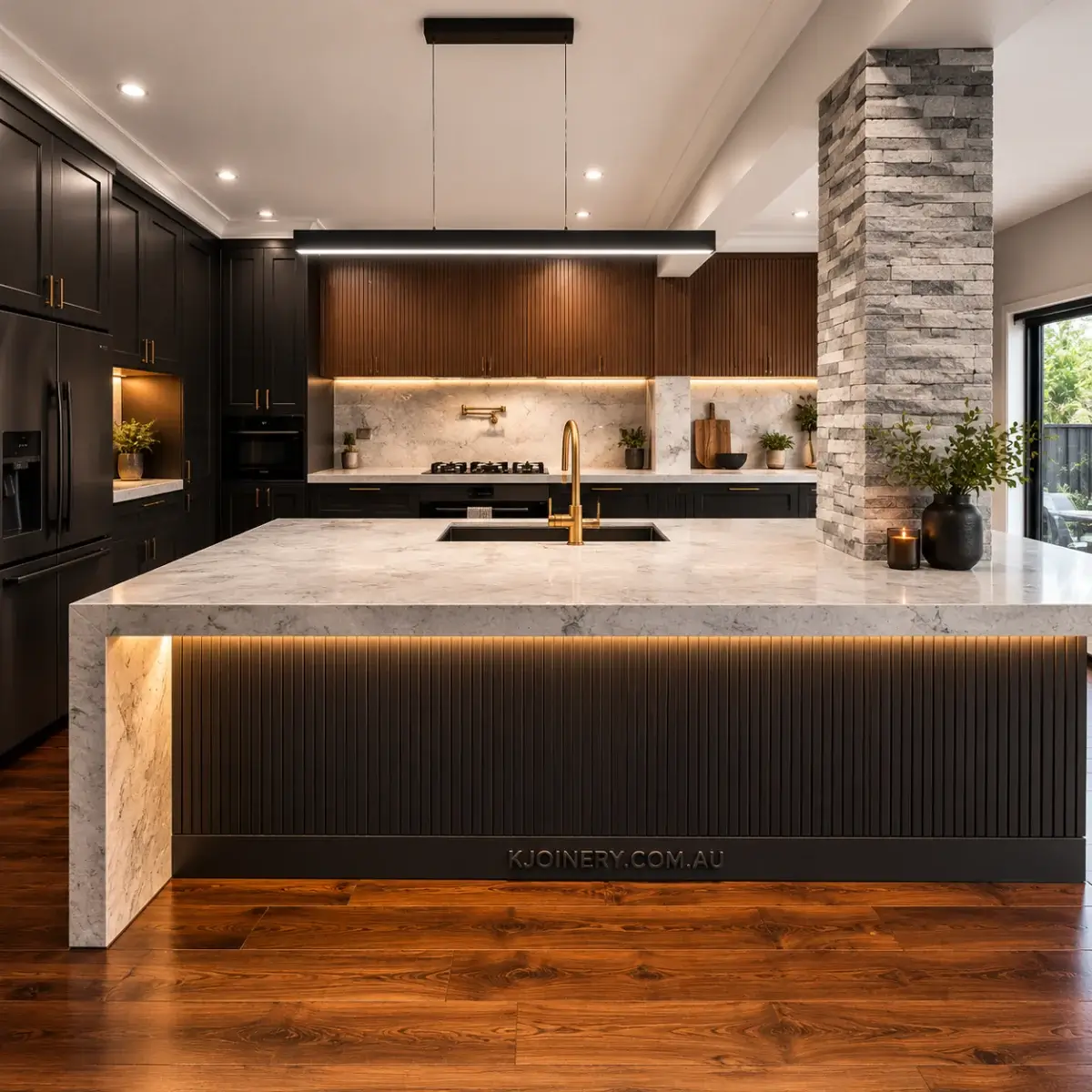
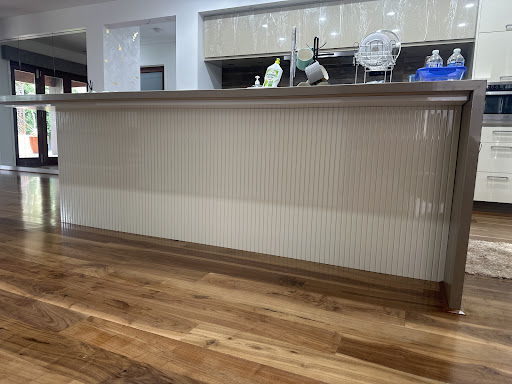
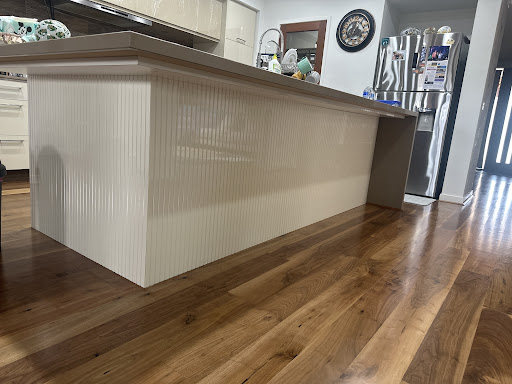
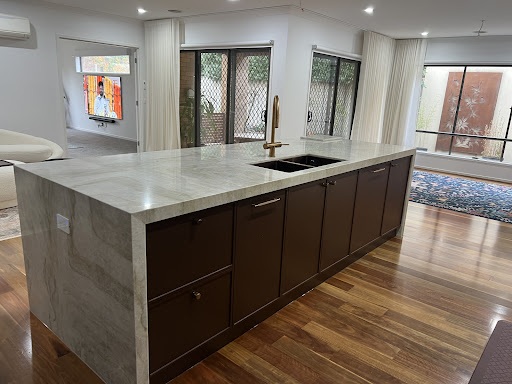
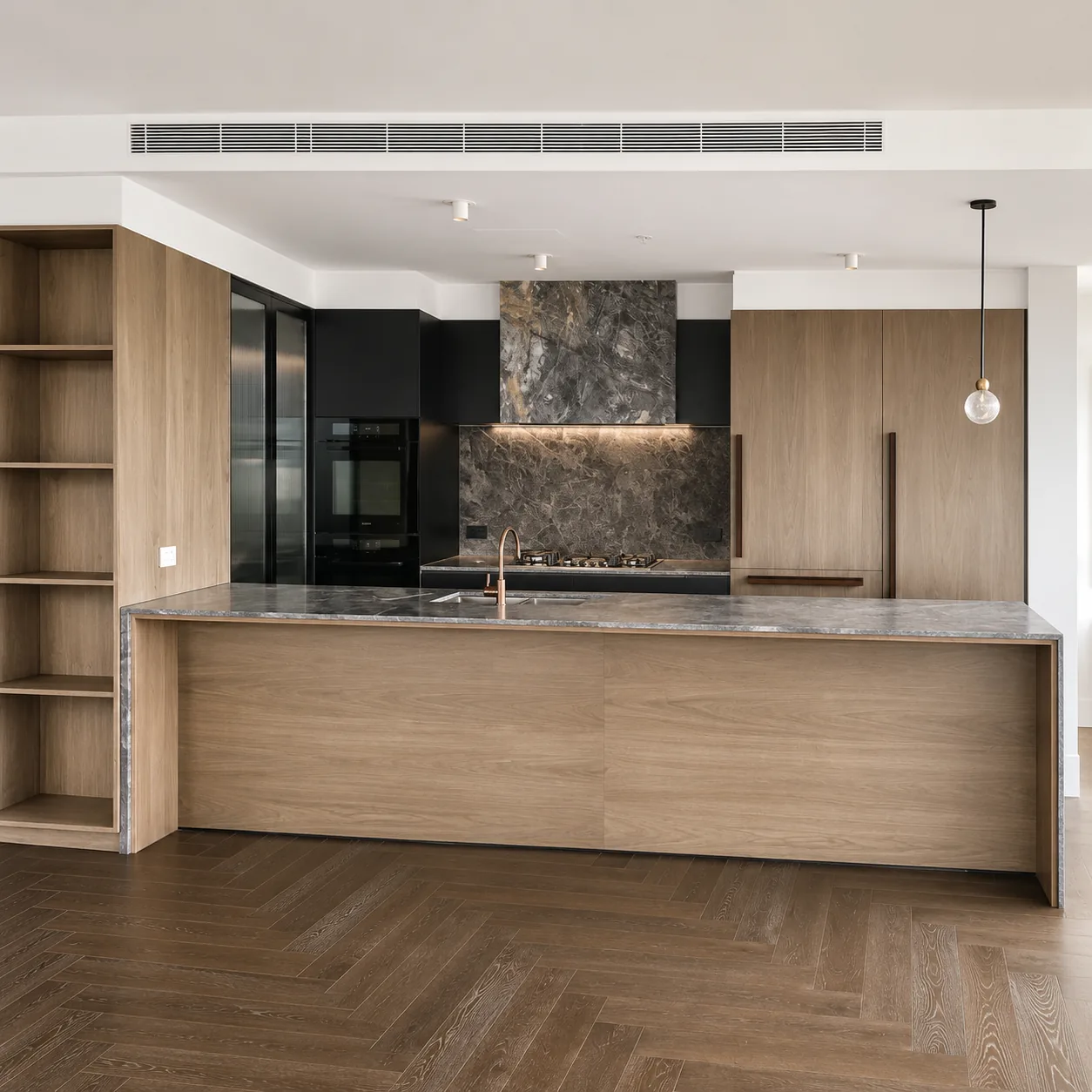
Painted MDF doors, stone island, quality hardware — the combination most families land on.The finish is what you touch every day. It is worth more of the budget than most people give it.
09 · The Verdict
So — are MDF kitchen cabinets any good?
Yes. For a painted kitchen there is nothing better, and that is not a budget conclusion — it is what the material does well. MDF gives you a dead-flat door that holds a sprayed finish beautifully, ignores Melbourne's weather, machines into shapes timber cannot manage, and stays square for decades.
It asks one thing in return: keep water off its raw edges. Specify moisture-resistant board through the kitchen, high-moisture board in the wet zones, seal every site cut, and fix leaks when they are small. Do that and the board will outlast the hinges, the runners and very probably your taste in colours.
The kitchens people stop and admire are almost never admired for their substrate. They are admired for a crisp finish, doors that line up, drawers that glide, and storage that makes sense. MDF is simply the material that makes the first two possible.
Choose the grade properly and MDF stops being the thing you settled for. It becomes the reason the kitchen still looks right in fifteen years.
10 · Common Questions
MDF kitchen cabinets, answered plainly
Are MDF kitchen cabinets any good?
Yes. For painted kitchens MDF is the best substrate available, because it has no grain to show through the finish, no knots and no seasonal movement. Its only real weakness is standing water against an unsealed edge, which is managed by using moisture-resistant board and sealing every cut.
How long do MDF cabinets last?
Well-built MDF kitchen cabinets typically last 15 to 25 years, and carcases often reach 30 or more. In practice the hinges, drawer runners and paint finish wear out before the board does, and all of those can be replaced without removing the cabinets.
Is MDF better than plywood for kitchen cabinets?
It depends on the job. MDF is better for painted doors because it gives a perfectly flat surface with no grain telegraphing through. Plywood is better in wet areas and for heavy shelving because it holds screws more strongly and tolerates moisture far better. Many well-built kitchens use both.
Does MDF swell if it gets wet?
Only if water reaches raw, unsealed board and sits there. Sealed and painted surfaces handle normal kitchen life without any issue. Permanent swelling almost always traces to a slow leak under a sink or dishwasher, or a site-cut edge that was never sealed before installation.
What is the difference between MDF and particleboard?
MDF is made from fine wood fibres pressed to a uniform density, while particleboard is made from coarser chips and flakes. MDF is denser, machines to a much crisper edge and takes paint far better. Particleboard is cheaper and is more commonly used for budget carcases.
Is MDF safe to have in a home?
Yes. Australian board is manufactured to AS/NZS 1859.2 and rated for formaldehyde emission, with E0 being the low-emission class specified for residential work. Once doors are sealed and sprayed, the surface in your kitchen is cured paint.
Can MDF kitchen cabinets be repainted later?
Yes, and it is one of the cheapest ways to modernise a kitchen. If the carcases and doors are still flat and square, they can be prepared and re-sprayed in a new colour for a fraction of a full replacement. Chips and dents fill and sand invisibly because there is no grain to match.
What grade of MDF should be used in a kitchen?
Moisture-resistant MDF should be the minimum anywhere in a kitchen, with high-moisture-resistance board under the sink, beside the dishwasher and in laundries. Standard raw MDF belongs only in dry areas such as wardrobe interiors and wall panelling.
11 · Where We Build
Custom kitchen joinery across Melbourne
We design, build and install custom kitchens, wardrobes and joinery across Melbourne, with most of our work in the west and south-east. If your suburb is on this list, we are close by.
Tell us about your kitchen and we will tell you exactly which board grade, finish and hardware we would specify — and what it costs. No jargon, no upsell.
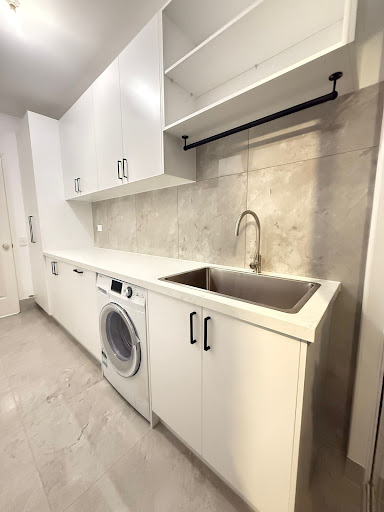
[…] under the sink. A laundry sees more steam and more spills than any other room. See our guide to which board grade belongs where. Benchtop Laminate is perfectly good here and takes a hot iron better than most people expect. […]
21 verified reviewers. Every one of them left five stars.
5.0★★★★★Rated 5.0 on Google
Drag to read more
IIman YusufAugust 2026
★★★★★
Thank you so much for transforming my walk-in wardrobe into a high-end space. You built a statement piece of furniture, and I can't get enough of it. It is worth every penny!
I highly recommend Meran and his team for outstanding craftsmanship and on-time delivery.
SSamantha ChakmaJuly 2026
★★★★★
We had a 70's kitchen that needed renovation and we went to Meran for that. We received quotes from many other cabinet makers but we are so glad we went with Meran.
Jenny SubandiJune 2026
★★★★★
Very happy with their excellent job for house renovation, bathroom renovation and cabinetry work that they did for me. Friendly and prompt service. Reasonably priced. Trustable team of tradies. Highly recommended.
Daria KozakApril 2026
★★★★★
I cannot thank Kjoinery enough. Responding to queries was fast, work was done at a very high level, communication with customers is fantastic. I am definitely going to cover all my furniture needs with their help in future. Really grateful for your work!
Such a great job,so happy with the outcome
Definitely recommend them,
Gracy RosalineNovember 2025
★★★★★
Amazing job — reliable, great quality, and very responsive. I’m extremely satisfied with the service. Meran is very easy to talk to, explains everything clearly, and really knows his work. Highly recommend.
We had Kjoinery / Mehran do our kitchen reno and we cannot possibly be happier with the end result. Every tradesperson we dealt with was respectful, professional, and easy to work with. They provided many thoughtful ideas and helped us get the design to exactly what we wanted.
From the design through to demolition and build, the whole process was smooth and well-managed. The attention to detail was excellent and the final result has completely transformed our home. Highly recommend Kjoinery for anyone looking for top quality work and a great experience from start to finish.
We used K Joinery for our Kitchen Renovation we are very impressed with the Amazing work by Mehran and His team.
The outcome is outstanding we went through a few companies but no one could really design the kitchen we had in mind until we found K Joinery and Mehran.
I highly recommend them.
Mary RomeoJune 2025
★★★★★
This was a challenging, customised job and the quality was good 👍🏿.
Stephen PeiLinJune 2025
★★★★★
May 2025.
I had some bookshelves made and installed recently.
Meran and crew did an excellent job; on time, on cost, excellent quality.
I highly recommend them.
Satyendra AluriJune 2025
★★★★★
Mehron did amazing work at our place in Williams Landing. He literally transformed our kitchen to a new contemporary design. He has been very patient since beginning of the project and did all the amendments as we requested, he never frustrates and always stays at client side to understand the vision and work accordingly.
I sincerely recommend him for any joinery works and he will certainly never disappoint anyone who opt to work.
Mehron, all the very best for your future endeavours and thank you once again for all the hard work and patience during the completion of our project 🙏
I’m extremely happy with the laundry cabinets Mehran built for us. He was professional, efficient, and paid great attention to detail. The quality of his work is excellent—the cabinets are well-built, functional, and have really transformed the space. Mehran was easy to communicate with and made sure everything was done to my satisfaction. I highly recommend him for any cabinetry work. Thank you, Mehran and Kjoinery.
Huge thank you KJoinery..
There is only one word you think of when you see their work….PERFECTION.
The service was highly professional and yet personal and friendly.
Their product is high end,but within a reasonable price.
The highlight of my house is my kitchen!!
I would not think twice before highly recommending kJoinery to anyone looking for class and perfection.
Anna.
Delivered and installed on time and on budget. Attention to detail and our requirements above expectations and an absolute pleasure to deal with. Highly recommended.
Amir MatinSeptember 2024
★★★★★
I recently worked with KJoinery for my cabinetry needs and was extremely impressed. The team was professional, efficient, and the quality of their work was exceptional. I customized the design to fit my needs and got great value for money. Highly recommend KJoinery for anyone in need of cabinetry services.
We recently worked with KJoinery for a custom cabinetry project in Rowville, and the experience exceeded our expectations. Mehran was incredibly attentive to our design preferences and ensured the cabinets were both functional and aesthetically pleasing. He was punctual, communicated clearly. for the quality of work provided, the cost was very reasonable, and there were no hidden fee or surprises. I highly recommend KJoinery to anyone looking for high-quality custom cabinetry and exceptional service.
Highly recommend Kjoinery for their quality and high standard of work!
Mehran was highly knowledgeable and guided us patiently to build our dream kitchen and bedroom joinery.
We couldn’t be happier with the workmanship and professionalism shown by Kjoinery throughout the entire process.
100% recommended to all friends and family.
Reza MoradiJune 2024
★★★★★
Highly recommended , the service and the pricing are the best ever I’ve experienced and looking forward to have another project to handed to them 👍👍👍
AUC ServicesMay 2024
★★★★★
We had a great experience with k joinery
Definitely recommend
Mehran and he is team was very professional
I highly recommend Kjoinery for their high standard work! Excellent and ethical quality .
Mehran was prompt , efficient and very trustworthy I couldn’t be happier and know that he will deliver professional work wherever he goes .very happy customer and will definitely recommend to anyone that needs good quality work .
Thank you Mehran 😊
We strongly recommend Kjoinery because Mehran makes the best kitchen and bathroom ! We had a great experience with him and he made sure he did a great job ! Whoever sees our kitchen/bathroom gives compliments and asks who made it. We have referred Mehran to many other friends and they were also happy with him. Also recently we bought another property and can’t wait for Mehran to do our kitchen and bathroom again! We are really excited !
Thank you so much for transforming my walk-in wardrobe into a high-end space. You built a statement piece of furniture, and I can't get enough of it. It is worth every penny!
I highly recommend Meran and his team for outstanding craftsmanship and on-time delivery.
SSamantha ChakmaJuly 2026
★★★★★
We had a 70's kitchen that needed renovation and we went to Meran for that. We received quotes from many other cabinet makers but we are so glad we went with Meran.
Jenny SubandiJune 2026
★★★★★
Very happy with their excellent job for house renovation, bathroom renovation and cabinetry work that they did for me. Friendly and prompt service. Reasonably priced. Trustable team of tradies. Highly recommended.
Daria KozakApril 2026
★★★★★
I cannot thank Kjoinery enough. Responding to queries was fast, work was done at a very high level, communication with customers is fantastic. I am definitely going to cover all my furniture needs with their help in future. Really grateful for your work!
Such a great job,so happy with the outcome
Definitely recommend them,
Gracy RosalineNovember 2025
★★★★★
Amazing job — reliable, great quality, and very responsive. I’m extremely satisfied with the service. Meran is very easy to talk to, explains everything clearly, and really knows his work. Highly recommend.
We had Kjoinery / Mehran do our kitchen reno and we cannot possibly be happier with the end result. Every tradesperson we dealt with was respectful, professional, and easy to work with. They provided many thoughtful ideas and helped us get the design to exactly what we wanted.
From the design through to demolition and build, the whole process was smooth and well-managed. The attention to detail was excellent and the final result has completely transformed our home. Highly recommend Kjoinery for anyone looking for top quality work and a great experience from start to finish.
We used K Joinery for our Kitchen Renovation we are very impressed with the Amazing work by Mehran and His team.
The outcome is outstanding we went through a few companies but no one could really design the kitchen we had in mind until we found K Joinery and Mehran.
I highly recommend them.
Mary RomeoJune 2025
★★★★★
This was a challenging, customised job and the quality was good 👍🏿.
Stephen PeiLinJune 2025
★★★★★
May 2025.
I had some bookshelves made and installed recently.
Meran and crew did an excellent job; on time, on cost, excellent quality.
I highly recommend them.
Satyendra AluriJune 2025
★★★★★
Mehron did amazing work at our place in Williams Landing. He literally transformed our kitchen to a new contemporary design. He has been very patient since beginning of the project and did all the amendments as we requested, he never frustrates and always stays at client side to understand the vision and work accordingly.
I sincerely recommend him for any joinery works and he will certainly never disappoint anyone who opt to work.
Mehron, all the very best for your future endeavours and thank you once again for all the hard work and patience during the completion of our project 🙏
I’m extremely happy with the laundry cabinets Mehran built for us. He was professional, efficient, and paid great attention to detail. The quality of his work is excellent—the cabinets are well-built, functional, and have really transformed the space. Mehran was easy to communicate with and made sure everything was done to my satisfaction. I highly recommend him for any cabinetry work. Thank you, Mehran and Kjoinery.
Huge thank you KJoinery..
There is only one word you think of when you see their work….PERFECTION.
The service was highly professional and yet personal and friendly.
Their product is high end,but within a reasonable price.
The highlight of my house is my kitchen!!
I would not think twice before highly recommending kJoinery to anyone looking for class and perfection.
Anna.
Delivered and installed on time and on budget. Attention to detail and our requirements above expectations and an absolute pleasure to deal with. Highly recommended.
Amir MatinSeptember 2024
★★★★★
I recently worked with KJoinery for my cabinetry needs and was extremely impressed. The team was professional, efficient, and the quality of their work was exceptional. I customized the design to fit my needs and got great value for money. Highly recommend KJoinery for anyone in need of cabinetry services.
We recently worked with KJoinery for a custom cabinetry project in Rowville, and the experience exceeded our expectations. Mehran was incredibly attentive to our design preferences and ensured the cabinets were both functional and aesthetically pleasing. He was punctual, communicated clearly. for the quality of work provided, the cost was very reasonable, and there were no hidden fee or surprises. I highly recommend KJoinery to anyone looking for high-quality custom cabinetry and exceptional service.
Highly recommend Kjoinery for their quality and high standard of work!
Mehran was highly knowledgeable and guided us patiently to build our dream kitchen and bedroom joinery.
We couldn’t be happier with the workmanship and professionalism shown by Kjoinery throughout the entire process.
100% recommended to all friends and family.
Reza MoradiJune 2024
★★★★★
Highly recommended , the service and the pricing are the best ever I’ve experienced and looking forward to have another project to handed to them 👍👍👍
AUC ServicesMay 2024
★★★★★
We had a great experience with k joinery
Definitely recommend
Mehran and he is team was very professional
I highly recommend Kjoinery for their high standard work! Excellent and ethical quality .
Mehran was prompt , efficient and very trustworthy I couldn’t be happier and know that he will deliver professional work wherever he goes .very happy customer and will definitely recommend to anyone that needs good quality work .
Thank you Mehran 😊
We strongly recommend Kjoinery because Mehran makes the best kitchen and bathroom ! We had a great experience with him and he made sure he did a great job ! Whoever sees our kitchen/bathroom gives compliments and asks who made it. We have referred Mehran to many other friends and they were also happy with him. Also recently we bought another property and can’t wait for Mehran to do our kitchen and bathroom again! We are really excited !
Thank you so much for transforming my walk-in wardrobe into a high-end space. You built a statement piece of furniture, and I can't get enough of it. It is worth every penny!
I highly recommend Meran and his team for outstanding craftsmanship and on-time delivery.
We had a 70's kitchen that needed renovation and we went to Meran for that. We received quotes from many other cabinet makers but we are so glad we went with Meran.
Very happy with their excellent job for house renovation, bathroom renovation and cabinetry work that they did for me. Friendly and prompt service. Reasonably priced. Trustable team of tradies. Highly recommended.
I cannot thank Kjoinery enough. Responding to queries was fast, work was done at a very high level, communication with customers is fantastic. I am definitely going to cover all my furniture needs with their help in future. Really grateful for your work!
Amazing job — reliable, great quality, and very responsive. I’m extremely satisfied with the service. Meran is very easy to talk to, explains everything clearly, and really knows his work. Highly recommend.
We had Kjoinery / Mehran do our kitchen reno and we cannot possibly be happier with the end result. Every tradesperson we dealt with was respectful, professional, and easy to work with. They provided many thoughtful ideas and helped us get the design to exactly what we wanted.
From the design through to demolition and build, the whole process was smooth and well-managed. The attention to detail was excellent and the final result has completely transformed our home. Highly recommend Kjoinery for anyone looking for top quality work and a great experience from start to finish.
We used K Joinery for our Kitchen Renovation we are very impressed with the Amazing work by Mehran and His team.
The outcome is outstanding we went through a few companies but no one could really design the kitchen we had in mind until we found K Joinery and Mehran.
I highly recommend them.
May 2025.
I had some bookshelves made and installed recently.
Meran and crew did an excellent job; on time, on cost, excellent quality.
I highly recommend them.
Mehron did amazing work at our place in Williams Landing. He literally transformed our kitchen to a new contemporary design. He has been very patient since beginning of the project and did all the amendments as we requested, he never frustrates and always stays at client side to understand the vision and work accordingly.
I sincerely recommend him for any joinery works and he will certainly never disappoint anyone who opt to work.
Mehron, all the very best for your future endeavours and thank you once again for all the hard work and patience during the completion of our project 🙏
I’m extremely happy with the laundry cabinets Mehran built for us. He was professional, efficient, and paid great attention to detail. The quality of his work is excellent—the cabinets are well-built, functional, and have really transformed the space. Mehran was easy to communicate with and made sure everything was done to my satisfaction. I highly recommend him for any cabinetry work. Thank you, Mehran and Kjoinery.
Huge thank you KJoinery..
There is only one word you think of when you see their work….PERFECTION.
The service was highly professional and yet personal and friendly.
Their product is high end,but within a reasonable price.
The highlight of my house is my kitchen!!
I would not think twice before highly recommending kJoinery to anyone looking for class and perfection.
Anna.
Delivered and installed on time and on budget. Attention to detail and our requirements above expectations and an absolute pleasure to deal with. Highly recommended.
I recently worked with KJoinery for my cabinetry needs and was extremely impressed. The team was professional, efficient, and the quality of their work was exceptional. I customized the design to fit my needs and got great value for money. Highly recommend KJoinery for anyone in need of cabinetry services.
We recently worked with KJoinery for a custom cabinetry project in Rowville, and the experience exceeded our expectations. Mehran was incredibly attentive to our design preferences and ensured the cabinets were both functional and aesthetically pleasing. He was punctual, communicated clearly. for the quality of work provided, the cost was very reasonable, and there were no hidden fee or surprises. I highly recommend KJoinery to anyone looking for high-quality custom cabinetry and exceptional service.
Highly recommend Kjoinery for their quality and high standard of work!
Mehran was highly knowledgeable and guided us patiently to build our dream kitchen and bedroom joinery.
We couldn’t be happier with the workmanship and professionalism shown by Kjoinery throughout the entire process.
100% recommended to all friends and family.
We had a great experience with k joinery
Definitely recommend
Mehran and he is team was very professional
KJoinery repliedthank you AUC Services, we are glad that you are satisfied with our work, we do value your five star and look forward if there is any other jobs coming up, best regards
I highly recommend Kjoinery for their high standard work! Excellent and ethical quality .
Mehran was prompt , efficient and very trustworthy I couldn’t be happier and know that he will deliver professional work wherever he goes .very happy customer and will definitely recommend to anyone that needs good quality work .
Thank you Mehran 😊
KJoinery repliedThank you so much for your glowing recommendation and kind words about Kjoinery! We are thrilled to hear that you are happy with our work, It's wonderful to know that Mehran was efficient, trustworthy, and professional in delivering excellent results for you. We truly appreciate your recommendation and are grateful for your support. We look forward to serving you and anyone you refer to us with the same level of excellence and dedication. Thank you for choosing Kjoinery!✨
We strongly recommend Kjoinery because Mehran makes the best kitchen and bathroom ! We had a great experience with him and he made sure he did a great job ! Whoever sees our kitchen/bathroom gives compliments and asks who made it. We have referred Mehran to many other friends and they were also happy with him. Also recently we bought another property and can’t wait for Mehran to do our kitchen and bathroom again! We are really excited !
KJoinery repliedWe are thrilled to hear that you had such a wonderful experience with our team at Kjoinery! We are dedicated to delivering exceptional work and providing our customers with beautiful results. Thank you for sharing your positive feedback with us. We look forward to the opportunity to work on your new property and create another stunning space for you to enjoy. Your satisfaction is our top priority, and we are grateful for your recommendation. Thank you for choosing Kjoinery!










1 Comment
Laundry Design Melbourne | Custom Joinery, Layouts & Storage
4 August 2026
[…] under the sink. A laundry sees more steam and more spills than any other room. See our guide to which board grade belongs where. Benchtop Laminate is perfectly good here and takes a hot iron better than most people expect. […]